Howzit friends,
If you've spent more than five minutes on YouTube or social media lately, you've seen the popular advice around marketing agents. Somebody leans into the camera and tells you they've built an agent for everything.
They've got a lead generation agent, a sales agent and a content agent, and apparently their entire marketing department now runs on autopilot while they sit on a beach somewhere sipping something with a little umbrella in it.
Let me save you some time and some stress. That's BS. Or, as we'd say back home in South Africa, it's a load of kak.
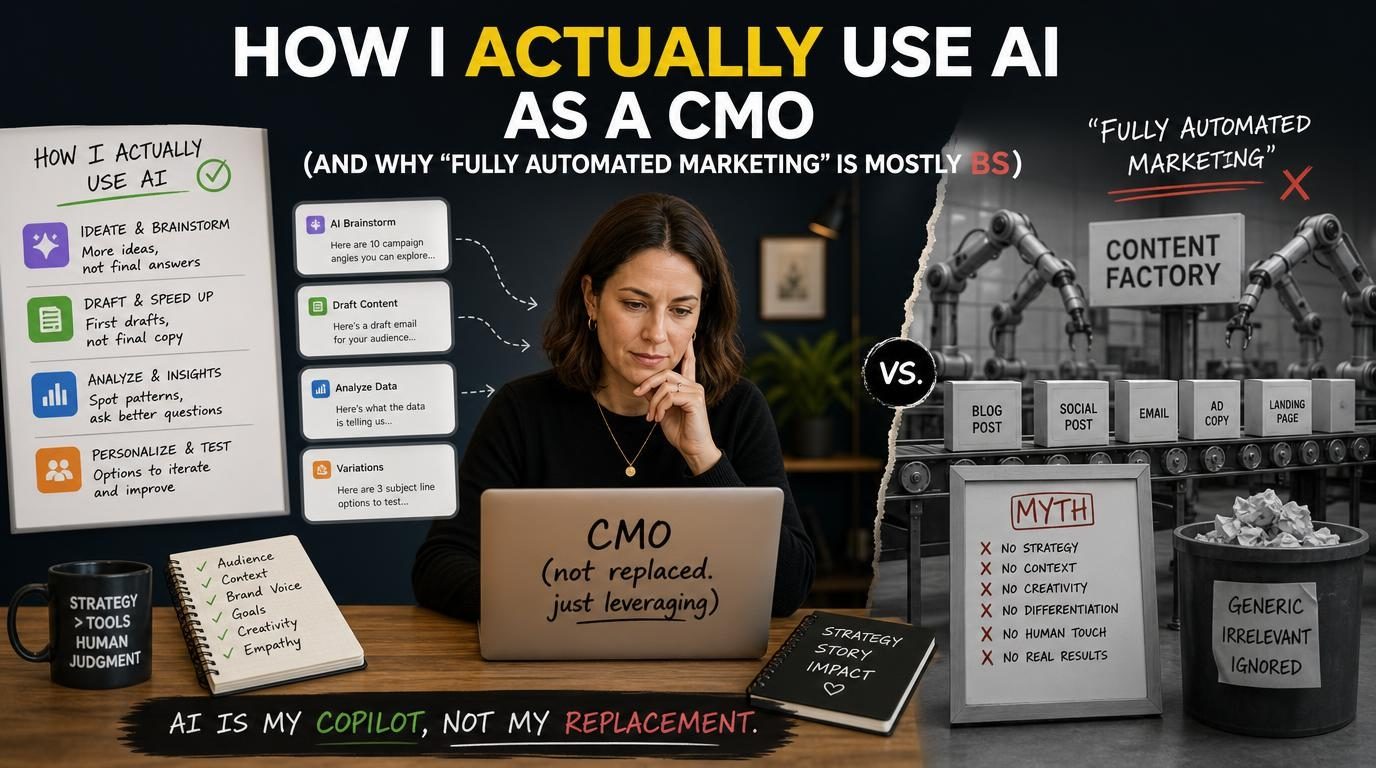
So I want to add my disclaimer right here. I'm not anti-AI. I'm the complete opposite and I love it. I use it every single day, I teach other marketers how to use it, and it has completely changed how I work as a CMO. But there's a big difference between what AI is actually doing inside real businesses right now and what's being sold to you in a sixty-second video with sharp edits and a trending audio playing behind it.
So today I'm going to pull back the curtain on exactly how I use AI in my own work. This is not an exhaustive list, but my main areas I am using it as of today (that will keep changing over time too). I'll show you the five areas where it really earns its keep, where I still don't trust it as far as I can throw it, and what all of this means for you as a business owner who wants to grow but doesn't have a big team or a big budget.
One quick heads-up before we start. I'm going to name a few of the tools I use, and this stuff moves so fast that by the time you read this, they may have a completely different name, or there'll be three new ones that do it better. Don't get hung up on the tool, mkay. Focus on the job it's doing.
Focus too on the systems and workflows that you create, so that you can move between different tools, with greater ease and without going totally insane.
First, what is an "agent" anyway?
Most of the confusion starts right here, because people throw the word around without ever saying what it actually means and what they say is an agent, isn’t truly an agent at all - yes I know that sounds confusing already.
So I’ll try to make it easier for you to understand. There are really three different things people call "AI" in marketing, and they are not the same thing at all.
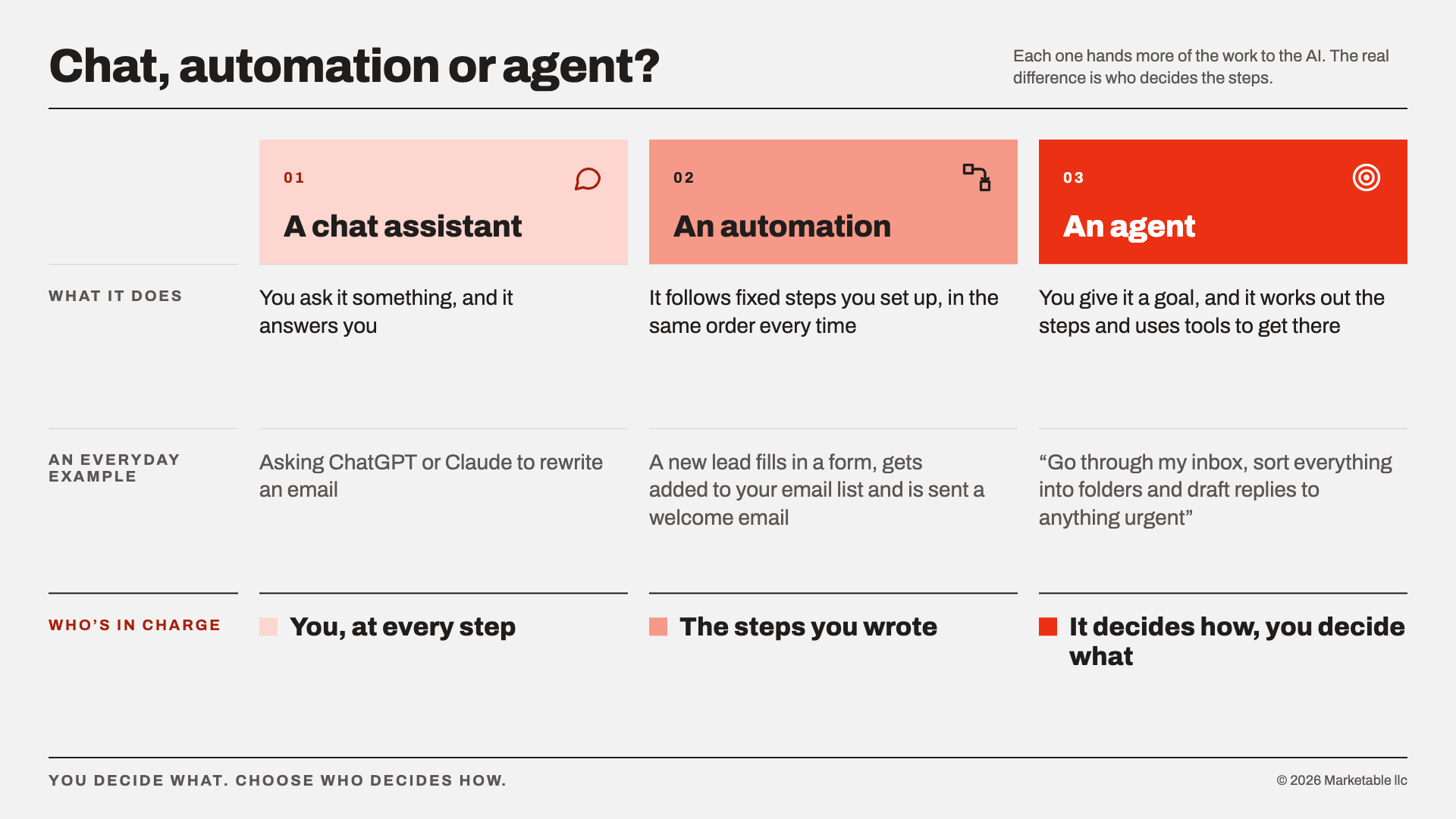
Here's the thing, though…automations have been around for years. Tools like Zapier have been connecting apps and allowing them to talk to each for years. In fact, I have been using it for over a decade.
A lot of the "agents" you see online are really an old-fashioned automation with one AI step plugged into the middle. There's nothing wrong with that, and it can be really useful, but it isn't a robot marketing department. It’s just an automation with a workflow.
I use all 3 on a daily basis, so I’m not trying to knock one or the other, just helping you understand what’s what, so you don’t get caught up in all the hype and feel like ou’re getting left behind.
I do use agents, and in a little bit, I’ll share with you how I use them. They do specific, well-defined jobs, and I check their work (always, always check their work). The way I'd put it is this: agents are good at jobs, but they're not good at judgment.
Where we actually are right now
Right now, we’re not at that fully automated point and a topic for another conversation is - do we really want to be? Anyhoo, on one end, there's you doing everything yourself by hand, the way we all did a few years ago. On the other end, there's this fantasy of a fully automated business where nobody needs to think.
Most of us are really in the middle, where AI is a work partner. It's like having a very fast, very well-read assistant sitting next to you who never gets tired and never complains when you ask it to redo something for the fifth time. Hey, I would also be complaining.
Despite my use of AI, I'm still the decision-maker. I'm still the one who sets the strategy, who knows the customer, who reads the room on a sales call, and who takes responsibility when a campaign goes sideways. My eyeballs are always on it.
My goal is not to be replaced by AI. My goal is to hand AI the stuff we humans are slow at, like trawling through mountains of data, so that I can spend my time on what actually moves the needle, which is the customer, the strategy and the creative.
Having said that, it is also a great teacher for me, to help catch my errors, my blind spots, knowledge gaps and also to bounce ideas off and expand my ideas.
So let’s jump right in, to the 5 ways I am using AI.
The five ways I use AI as a CMO every week
1. Research
This is one of the areas where AI is genuinely phenomenal and has saved us huge chunks of time. We use it daily to research competitors, markets, buying behavior, patterns, gaps and opportunities, pricing, audiences, positioning, content ideas, and so much more.
For example, before I start with a new client, I'll have it dig into who their main competitors are, what they charge, how they position themselves, and what their customers are raving or complaining about in their reviews. Those complaints are gold, BTW, because every complaint about a competitor is a gap you could fill.
Research like that used to take me days or a week, now I can get it done in a matter of hours. Even the really detailed and complex research, which used to take me one to two weeks, now takes a couple of days, and I get to spend that time thinking about and interpreting what it all means instead of sifting through hundreds of web pages, forums and sites.
2. Building a brain
This one is less obvious, and it's where things really start to get interesting.
Out of the box, an AI tool is so amazing, but the big problem is that it knows a lot about everything and nothing about you. Every time you open a fresh chat, it's like meeting a very clever stranger; you have to explain your whole business all over again. To be honest, that piece is getting better, but it still tends to dilute its results, take shortcuts, make stuff up or not follow the process - it’s like the potentially brilliant employee who is inconsistent and can go a little off the rails at times too.
So I've spent time building it a brain. That means giving it memory, so it remembers my business, my clients, my frameworks, systems, thinking patterns, processes and how I like things done. It also means teaching it skills, which are basically written instructions for a task I do over and over, so it does that task my way every time instead of its own way.
My writing is a good example. I've taught it how I write, the phrases I use, the things I never say, and how I like an article to flow. Without that, it writes like everybody else's AI, in that generic and bland, slightly over-polished voice you can now spot from a mile away. So by training it and improving the “harnesses,” it functions a lot more like how we want it to and the result is that the first draft gets a lot closer to sounding like me or client, and then we have a strong platform to build from there.
This matters for you too, because when everybody uses the same tools with the same prompts, everybody's marketing starts to sound exactly the same. Your stories, your experience and your way of doing things are the real advantage you've got, and building the brain is how you get the AI to become more focused and specialized around you and your approach.
3. Analysis
Just like the heavy, data-intensive work of research, analysis is another area where it really shines and saves me hours and days of work. I don't know about you, but handling huge amounts of data isn't always fun, and it's exactly what we humans are slow and clumsy at.
One of the big issues with marketing is that there are always large amounts of data, spread across multiple systems and not always presented in a way you want to see that data. So for example, when aggregating data to measure KPIs (Key Performance Indicators), spotting trends in the data, and analyzing funnel performance and ad performance.
Recently, Meta’s new Muse agent has been really powerful for us to take our ad data and get useful insights quickly and easily, just by asking it to grab certain data points, interpret data or do a fresh analysis. I love this agentic tool, and especially that I can just dictate to it and get the answer on less than a minute.
Analyzing data like that used to take me anywhere from four to six hours. Now I can often get it turned around in 15 to 30 minutes. And when you consider that I'm looking at data every single day, that adds up to a serious number of hours.
I can set it up to give me a snapshot at a certain time each day of my ad spend, my cost per lead (which is simply what I'm paying for each new lead) and my number of leads, along with a daily breakdown of every campaign and whether anything is moving.
But it's not only numbers. I record my calls, so I can give it the transcripts of conversations with prospects and clients and ask it what people keep saying, which objections keep coming up, and what words they use to describe their problem. I can do the same with customer reviews. That's the kind of gold that used to sit in a notebook, or in my head, and never got properly looked at.
Finally, one of my clients has their data on 4 different platforms - the CRM, Hyros ad data, Meta ad data and their software which captures and records the sales. Analyzing the 6 campaigns we are running each week took an enormous amount of time - now with an agentic AI solution, we get our data reports or consolidated and reconciled at a specific day and time each week and it has saved me and the team hours and days - that’s no exaggeration.
4. Creation
This is one of my biggest focus points at the moment, and it's also where I have to be the most careful.
I'm using AI to help me write the copy, which includes all the ads, emails, landing pages, video scripts, content ideas and so on. At the same time, I'm also using AI to create images, or to help me create images, video and designs at scale. It allows me to turn my voice into text and text into voice, and it really helps me build presentations that are nicely branded and aligned with our brand, without having to send them to a graphic designer.
It's also helping us write up our SOPs and processes, along with summaries of any of the training sessions we've done, internally or externally. By the way, if you don't know what SOP stands for, it's a standard operating procedure, which is basically our step-by-step "here's how we do this" document.
I also use it a lot for creating slides, because I do a lot of presentations, trainings and talks. Making changes and having everything beautifully presented and branded used to take me a few days. Now I can get it done in a couple of hours, and sometimes even less time than that.
The other thing that can be quite time-consuming, and not as glamorous, is resizing. Once we've designed our ad images, Meta needs three or four different sizes of each image based on ad placement, which is simply where the ad shows up, like the feed, stories or reels. That used to take us hours after we'd created the original, and now we can use AI to do it for us. We're also increasingly using AI to edit videos, which saves us time and saves us money.
I also use it to build things that were pretty much out of our realm of possibilities. For example, we've taken a lot of the spreadsheets and templates that we used to hand to our clients and use internally, and we've built our own apps out of them. That includes invoicing systems, funnel monitoring software, assessments, audits, and dashboards for tracking all kinds of performance, such as funnels and ads. And we can do this without having to write a single line of code.
So all of a sudden, I'm creating all these amazing apps using what's called vibe coding, which is when you just speak in plain English and the AI writes the code for you. All of a sudden, I'm feeling empowered. And by the way, let me add a little disclaimer here…it actually becomes quite addictive once you start creating.
Not too long ago, I would have had to hire a developer for all of these. I'd have to explain what I wanted, there'd be multiple rounds of back and forth, it would cost money, and the stuff would take months to create and need a much bigger budget.
Here's a good example of how that pays off. I used to compile my reports by hand every week, and it took me hours. Now my own app does it automatically, so I just open it up, see a snapshot on the dashboard, and drill down into the detail whenever I need to. I'll be honest, it took me a few weeks to build that app, so it wasn't magic. But the time it saves me every single week since then has been huge.
But here's the big difference from the first three areas. On creation, I am still the director, and I'm still directing the creative process. I can't just tell it "make me an ad" and hit publish, because then it just becomes slop, like every other piece of generic AI slop out there. It doesn't know which image will stop my customer or my prospect mid-scroll. It doesn't give my client consistency in their output if they want a consistent look, the same model, the same lighting and so on, so it all just ends up looking haphazard. And it doesn't know which line or piece of copy is truly going to make them feel understood and connect with them.
Think of it like a film set. AI is a brilliant crew, but somebody still has to yell "action" and decide which take makes the final cut. It gives me options and a fast first draft, and I decide what's good, what's off-brand, and what's just plain wrong.
I'll walk you through my actual workflow for creating hyper-realistic images in a future post, because that one deserves an article of its own.
5. My executive assistant
Hallelujah! This is another huge moment for me, because this is where I actually use agents, and it has made a massive difference to my week. And truly, this has only really happened over the last month or two.
I use Grok Bot, which comes from xAI. It's connected to my Gmail, my Slack, my Google Drive, and even the creative software I use for images. Inside it, I've got a chief of staff agent, a research agent, a content creation agent, an analysis agent, and a whole bunch of other agents doing work for me. I can work with them on new projects, or I can give them specific scheduled tasks that they go off and do, and then they come back to me.
So every day, for example, it checks my email, tells me what's outstanding and what I've got to reply to, and sorts and tidies up my inbox. It communicates with me and gives me summaries, and it asks things like, "What do you want me to do, Kenneth? Do you want me to reply?" It drafts replies for me, it keeps track of my projects, and it nags and reminds me about the things I've been putting off. ("Kenneth, you still haven't done this.") It'll even come back to me with something like, "We ran that analysis on the event for you, and here are the numbers."
Now here's the funny part, and I think it's the most honest thing I can tell you about agents. I don't have one giant, all-knowing agent running my life. I break it out into several, because it's easier for me to follow. And if I'm being totally honest with you, most of those "agents" are really just separate chats that I've given a job title and a set of instructions. That's it. That's my "AI marketing department." It's powerful, and it saves me hours every week, but it isn't running my business while I sleep.
A bonus one: my thinking partner
Being an entrepreneur or a founder can be a lonely journey, and you don't want to do this stuff alone. This is where I sometimes wish I was just in an office with people I could bounce ideas off.
This one doesn't really fit into any of the previous five, but it's so, so important and very, very valuable, and probably the most valuable of the lot. I use AI as my sparring partner and my brainstorming partner. I throw new ideas at it, and I get it to test me and push back on me. I'll throw down an idea and ask it to poke holes in it, play devil's advocate, and tell me where my knowledge gaps and blind spots are.
This very article is a good example. I scribbled my notes on a notepad, read them out loud, and asked it, "What are my blind spots?" It came back with a handful of things I'd completely left off my own list. I still decided what went in and what didn't, but it got me there much faster.
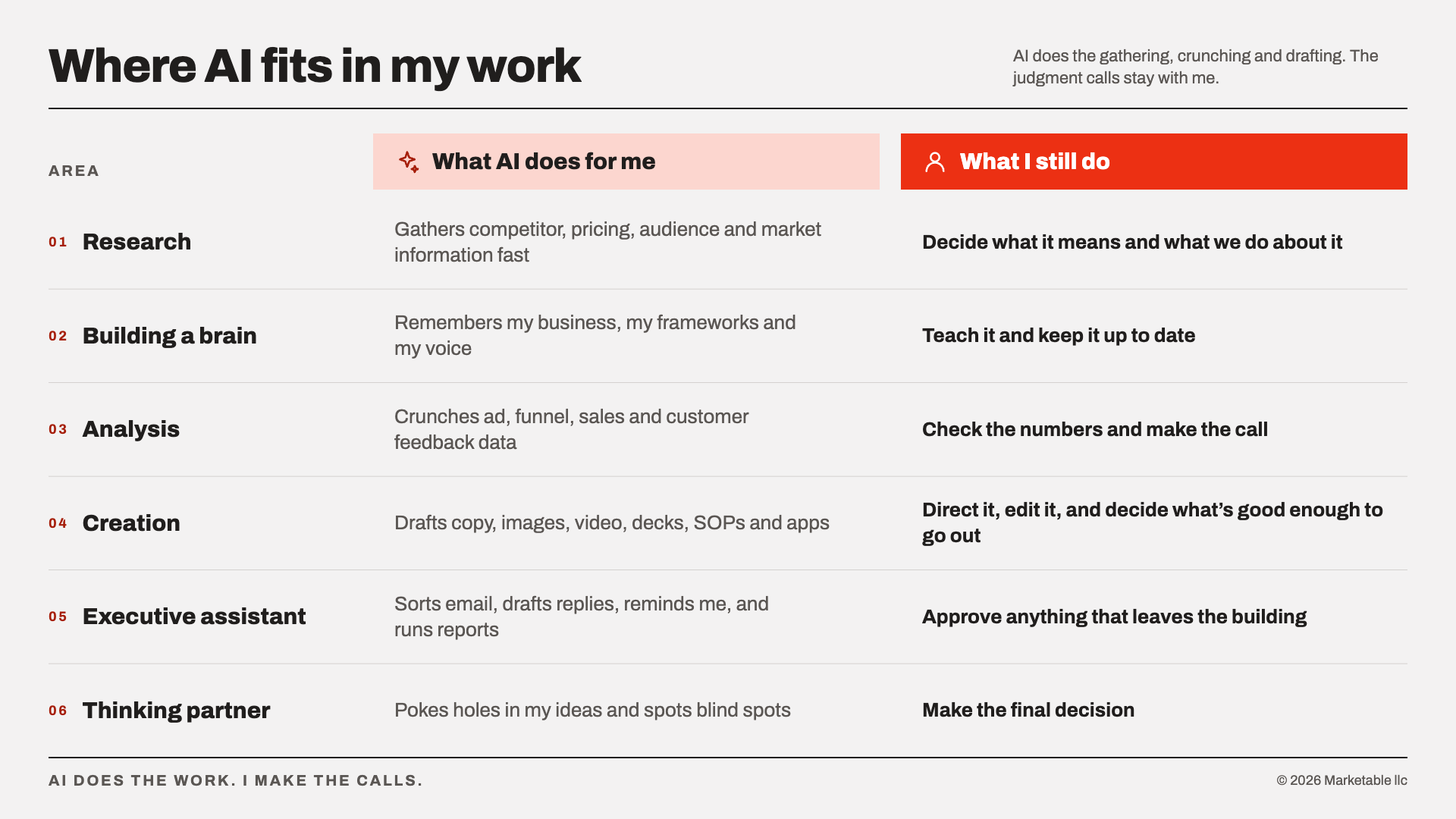
Here's how it all looks side by side:
And because I know you're going to want the actual numbers, here's roughly how much time it's saving me:
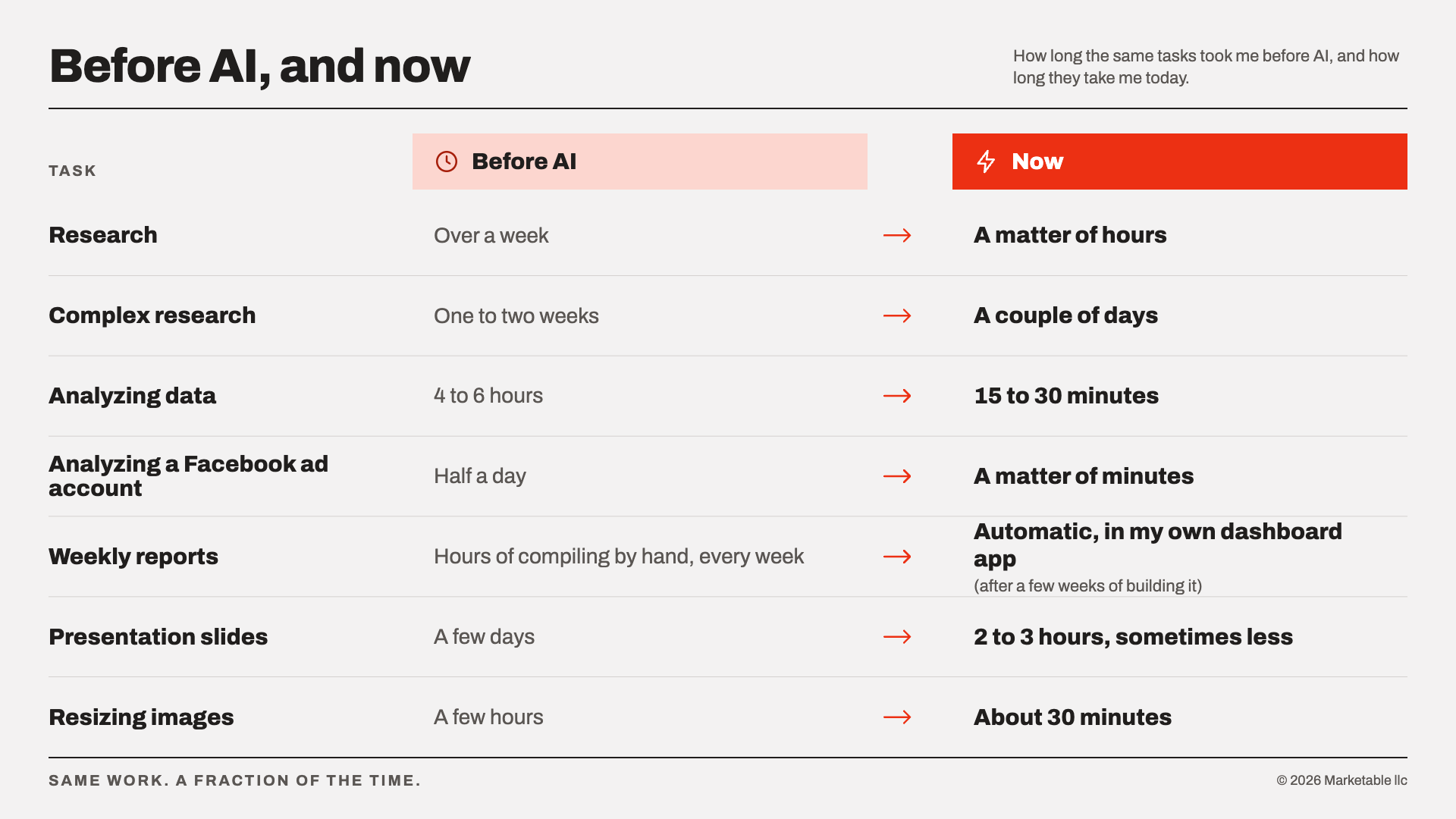
Have a look at that data line on its own. I'm in the numbers every single day, so saving several hours on that one task alone gives me back a big chunk of every week. That's time I now spend on clients, strategy and the creative, which is exactly where I want it.
The moment it really clicked for me
Let me give you a real example from just recently.
I teach business owners and marketers how to become a chief marketing officer, and over the years I've built my own workflows for how I break down a client's marketing, step by step.
Designing those workflows as visual maps on Miro, which is an online whiteboard, used to take me hours, sometimes days, and sometimes weeks.
This time, I explained to AI exactly what I wanted to build. It gave me a first version, I said tweak this and change that, and we went back and forth a few times. In a couple of hours, we'd built the whole structure, and it's now something I use with my clients and teach to my students.
But here's the part I really want you to hear. It only worked because I already knew exactly what I wanted. I've been doing this work for years, so I had the clarity. The AI didn't come up with my process, it just helped me get it out of my head and onto the board at ridiculous speed.
That's the real lesson in all of this. AI multiplies clarity, but it doesn't create it. If you know where you're going, it'll get you there at warp speed. If you don't, it'll just help you get lost faster.
And that's exactly why I keep banging on about focus. AI won't tell you which part of your marketing needs fixing first. If you haven't read my article on where you should actually focus your marketing, start there, because that's the thinking you need to do before any tool can really help you.
Where it gets things wrong (and it does)
What I've been explaining and sharing with you here may sound a little bit magical, and to be honest, I'd be doing you a disservice if I made this all sound so rosy and so perfect, because as brilliant as it is, it isn't perfect.
AI has shared incredible research and insights with me. But every now and again, it has come along and confidently told me things that were not just a little bit off, but completely wrong. I've witnessed it invent numbers out of thin air. It has told me and presented "facts" about companies that were totally inaccurate or made up. It has gotten dates, names and timing wrong. It has even told me I said something on a call that I never said.
There's a name for this, and it's called hallucinating (and there's probably some other internal AI jargon for it that I'm not familiar with). Hallucinating is really where AI makes something up and presents it as if it's true. It's sort of like that know-it-all kid version of yourself, telling a story and too scared to say, "I don't know that part," so you'd just fill in the gaps and hope nobody would notice. AI is doing the same thing.
Now, the dangerous part is not that it gets things wrong, because let's be honest, we do too. The dangerous part is that it gets things wrong in a beautifully written, totally confident way that makes you want to believe it. So who is ultimately doing the checking and making sure?
So here are the three rules I follow to make sure I don't get caught with my proverbial pants down.
Check everything that matters. Any number, any fact about a real company, and anything that's going in front of a client gets double-checked by a human, and I do that every single time. When AI is doing research for me, I ask it to give me its references. The other thing I do is take that research, run it through another AI and say, "Please fact-check everything here for me." So you can get one AI checking the work of the other AI.
You can even automate that. Once the first AI has completed the research, you ask it to put it in a Google Drive folder, and then you tell your other AI to go and check that folder at a certain time and verify and validate everything. If you wanted to, you could even add a third AI. So not only am I using different AI models to fact-check each other's work, but I'm also using my own eyes.
Remember it's only as good as what you feed it. It's garbage in, garbage out. If your tracking is broken, it can happily give you a gorgeous report built on bad numbers. Now, that's not always the case, because it's typically pretty good at calling out a gap and saying, "Hey, there's something missing here." But every now and again, it will hand you that gorgeous report built on bad numbers, so you have to be sure that what you're giving it is accurate.
And quite often, the bad result actually comes from the lack of clarity you've given the AI. It's the same as handing a handful of reports to a human employee without good context and without clearly stating your goal and objective. That employee can get it horribly wrong, and the same thing goes for AI.
Be careful what you connect it to. When you give AI access to your email, your files and your customer data, you're trusting that tool with private information, and that includes your clients' information. Read the privacy settings. Check in with your client and get it approved. Think about what you're handing over, limit what it has access to if need be, and if a client has asked you to keep something confidential, keep it out.
That's why you always need human oversight. I don't just mean a human in the loop saying, "Hey, I'm here." I mean someone overseeing and building everything, so that private data and information that shouldn't be shared isn't shared. That's not because these tools are bad or have some malicious intent. It's because somebody has to be responsible for what goes out the door.
And again, I'm going to bring this back to people. You're not going to let every employee across your organization access any piece of data, any bit of private data or any client information willy-nilly. There are rules and compliance around that. When I worked in investment banking, I couldn't just walk across from one department to the other. Compliance set the rules, and we had to follow those rules and processes to protect private information and prevent the open sharing of sensitive information. The same thing applies to AI.
So what does all this mean for you?
As you can see, I'm genuinely excited about all of this, despite all the nonsense floating around online about magical automated systems and agents.
Most of the business owners I talk to want to grow, but they can't afford a full marketing team when they're starting out. Or if they can, they might have access to one person, maybe part-time, but they can't have a full suite of employees like a researcher, a data analyst, a copywriter, a designer, a developer and an assistant. That would be a lot of money, right? That's six salaries, and for most small businesses, even successful small businesses, that's simply not going to happen, because it's out of reach and out of the budget.
So when people say AI is replacing humans, I actually disagree. I think they're missing the point for the small business owner or the solopreneur, and I'm speaking solely from a business perspective here. It isn't replacing the people you have. In fact, it's quite the contrary, so let me explain.
Number one, it's doing the work that your business could probably never afford to hire anyone for in the first place.
Number two, even in the biggest companies, what I consistently hear from people like the CMO of a Fortune 100 company is that their employees are only spending 25% of their time on the work they should be doing, which is customer-centric work like focusing on the customer and improving their experience. The other 75% of their job is mundane, tedious, operational work.
What AI is allowing the employees in these big companies to do is increase the time they dedicate to value-adding, customer-centric work, and decrease the repetitive, mundane tasks, which can be picked up by AI. So they're actually being empowered, and they're part of the value creation process. Their role changes significantly, and that is the huge, huge unlock, not only for small businesses, but for medium-sized businesses and huge international conglomerates too.
Now, for you as a business owner, AI used properly, with a clear strategy and a human in charge, is going to unlock whole new opportunities for you. It gives you speed and efficiency, and it allows you to punch well above your weight. It lets you get done in an afternoon what used to take a week, or even multiple weeks. And it frees up your time to spend on the things AI can't do, like understanding your customer, making the big decisions, building better relationships, and creating more value and connection with your clients.
AI won't replace a good marketer. But a good marketer using AI can now do the work of a small team, and that's exactly what a business with a limited budget needs.
Where to start this week
You don't need to build a whole army of agents this week. Phew, I've let you off the hook on that one. Just start with one thing. That's how we started, and it's how we got to where we are today, which is still far from where we want to be.
Pick the one task you do every week that you dread the most, because it's slow and repetitive and it's taking you away from what you really want to be doing. Maybe it's pulling your weekly numbers. Maybe it's answering the same customer emails over and over. Maybe it's research, checking what your competitors are up to, or reconciling bank statements.
Open up an AI tool (I actually recommend Grok Bot or Muse as a simple starting agent right now), and explain that one job to it the way you'd explain it to an assistant on their first day. Then see what it comes back with, and work from there. If you're spending a lot of time in email, for example, you'll be surprised and blown away by how quickly it can help you with that, and it can free up hours of your week.
Then check its work, every time, at least until you've seen enough to know where it's reliable and where it isn't.
And one more thing before you go. If you want to find out exactly where your business is missing opportunities, I've built a free tool right on my homepage. Answer a few questions and it'll give you your score then and there. Click here to check it out.
Coming up soon, I'll walk you through one of my actual workflows, which is how I create hyper-realistic images with AI, so keep an eye out for that one.
Chat soon and here's to your growth and your new partnership with AI,
Kenneth