Where Should You Actually Focus Your Marketing?

With all the shiny objects and options available to you as a business owner, where do you actually focus your marketing energy and time?
This is one of the biggest challenges businesses face every single day. And today, from beautiful Carlsbad in California (BTW, you should come visit), I'm going to share with you exactly why this overwhelming number of options is weighing business owners down.
I am then going to share with you the six simple areas of focus that give you clarity, give your team focus, and give you a straightforward action plan to move forward.
First, what all this scatter is actually costing you
Before we get into the six areas, I want you to be honest with yourself about the price you're paying for not having them.
When there's no clear focus, the money goes out anyway. You run a bit of paid traffic here. You pay someone to do social there. You buy the course, you sign up for the tool, you try the new platform everyone's talking about.
You're spending, but you're not building.
But still, your marketing is not really moving the needle at all. Super frustrating, I know.
When I visit most businesses, I see that when it comes to marketing, it's rarely connected to the next thing, so none of it compounds.
Here’s the truth, though…Your team feels it worse than you do, but they don't want to tell you. They're being pulled in all these different directions at once because the priority changed on Monday and changed again on Thursday.
Nobody can tell you what they're actually responsible for improving, because it keeps moving. Good people get tired of that.
And then twelve months goes past.
You've been busy the entire time. You've got the receipts to prove it. But when you look back, there's no system sitting there that you could point at and say "that's the thing that brings me customers."
You've got activity. You don't have an asset.
That's the real cost. Not the ad spend. The twelve months.
Now, despite me saying I am going to share with you the 6 core areas of focus, remember this: I can't remove the distractions. They will keep coming, because those are external forces. That is gonna fall on you, mkay.
What I can promise you is that if you focus on these six areas, you'll have clarity, focus, and an execution plan that the entire company can follow. And when that happens, your team will feel empowered with the clarity and responsibility, and you won't get distracted, and you'll stay on track.
One more thing before we get into it. Everything I'm going to share with you has to be measured and reported on. There's no guesswork. There's no "I think" or "I have a hunch." Our actions are based on actual feedback and data from all of our marketing activity.
And not to worry, I'll share with you exactly which numbers to watch further down.
The six growth levers
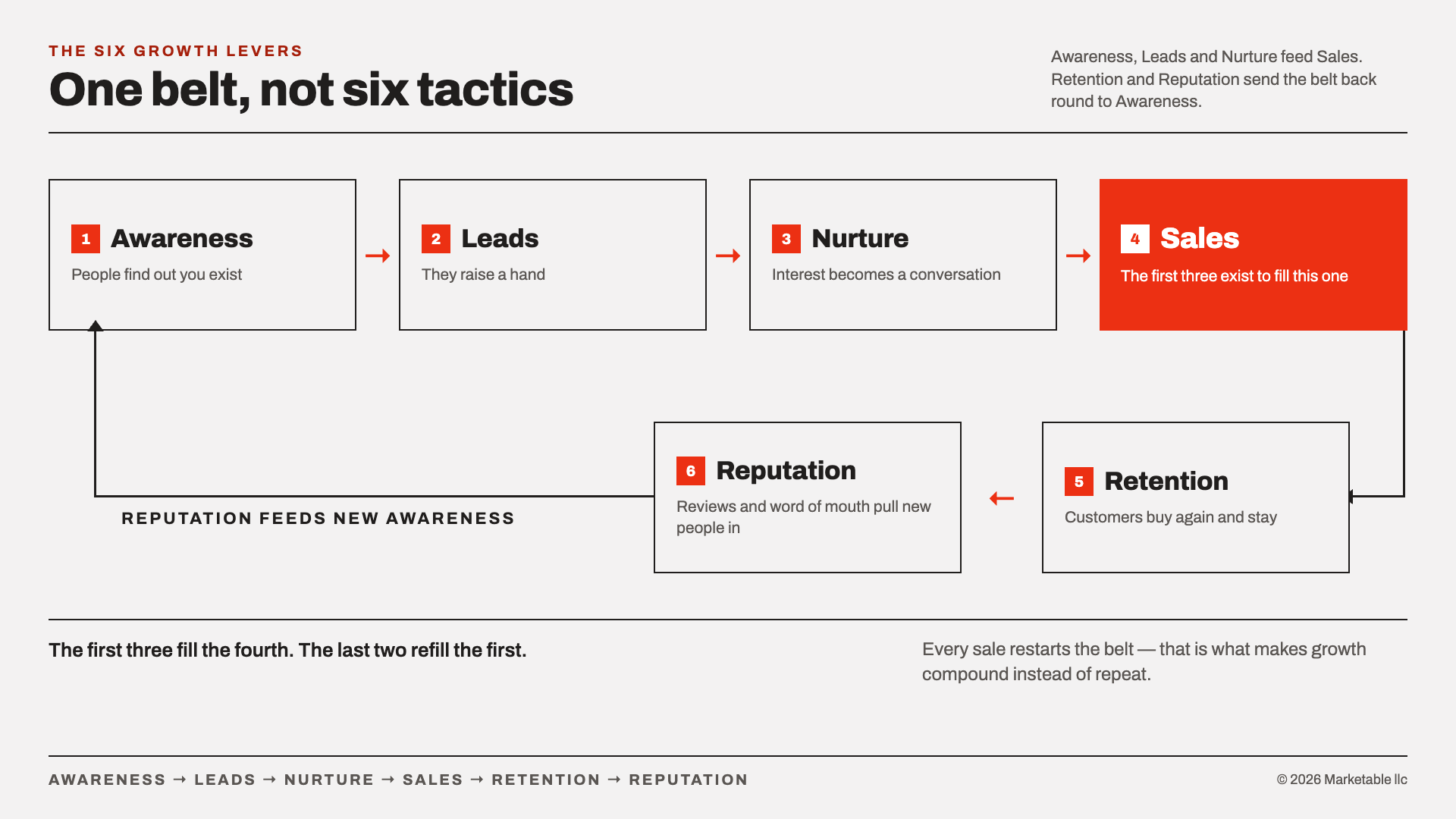
Every business, no matter where you are, has to focus on six key levers — what I call Growth Levers — in order to successfully grow their business with their marketing. Let's take a sneak peek at each one.
1. Awareness
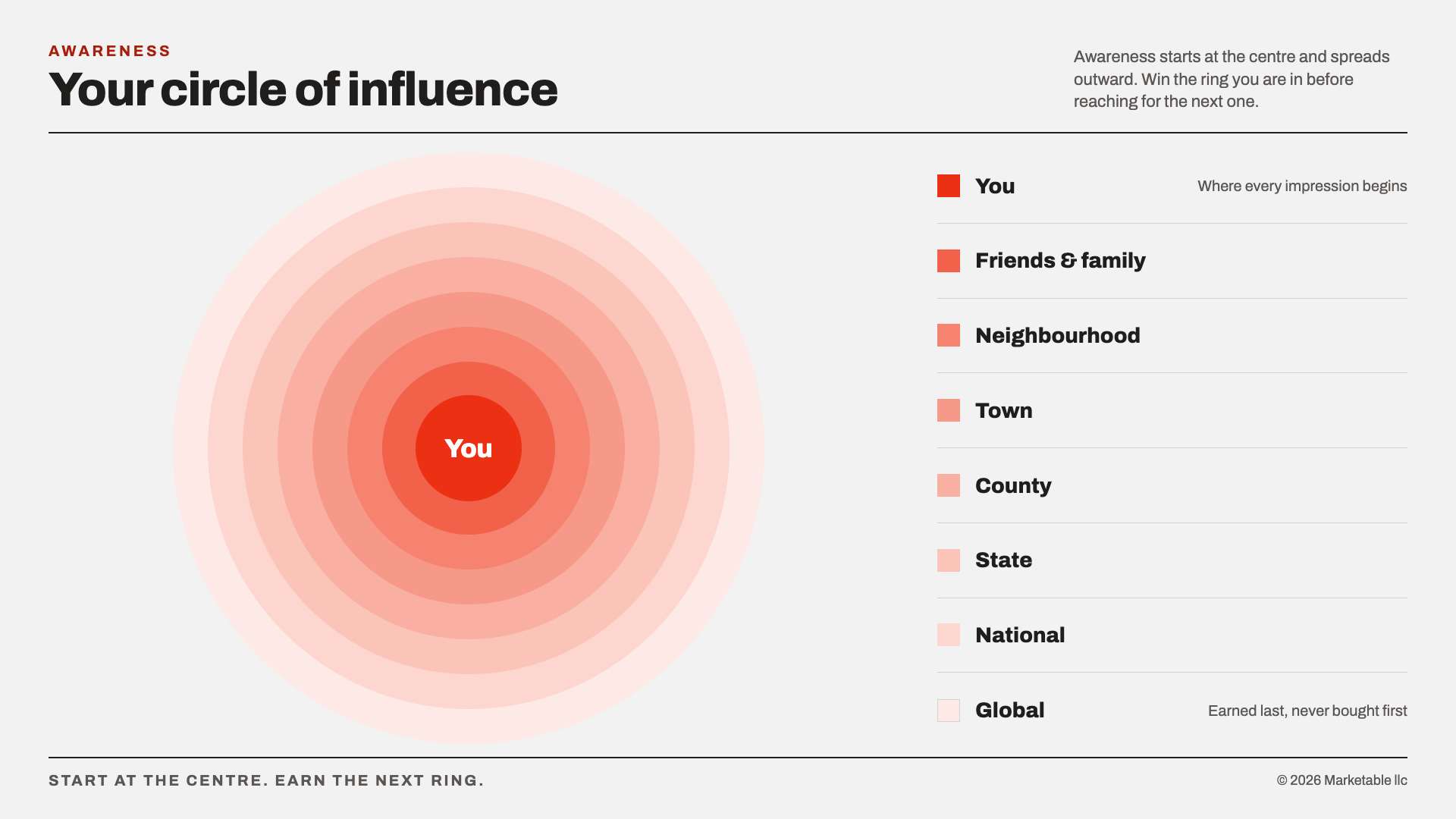
The goal of the awareness lever is to let more and more prospects know about your business: what you do, who you serve, and how you can help them.
Think of it as your circle of influence. You want to keep expanding that circle until more and more people know you, know about your business, know what you do, and know who to call or visit when they need a solution.
A simple way to think about it is this. When you first start your business, your circle of influence is typically small. It's your partner, your friends, your family. That's your warm audience.
And you're going to want to go beyond that, because you can't rely on your wife and your cousin and your grandma buying your products and services. Chances are, they're not even your ideal client anyway.
So you go beyond your warm audience and into the realm of cold audiences, i.e., people who have never, ever heard about you. You expand that circle from your neighborhood, to beyond your neighborhood, to your whole town, to your county, to multiple counties, to your state, to multiple states, across the whole of the US, and then globally if that's your focus.
So we are always expanding our circle and raising awareness. Remember this…without awareness, people don't know you exist, they don’t know how to find you, and therefore, they can't buy from you.
2. Leads
The second lever follows straight on from the first. Once I have awareness — which is really people's attention — what do I do with it?
I want to convert that attention and capture it as an actual lead.
A lead, from a marketing perspective, is typically a name, an email address, a phone number, or even a traditional mailing address.
What we're doing is taking the casual visitor — the person walking past your main street store, to use an analogy — and turning them into a lead. Somebody who is curious and a little bit more committed.
Now here's the most important thing, and this is where a lot of business owners get it wrong. Don't assume that just because somebody becomes a lead, they are your prospective client. It's just a lead at this point.
These new leads sit at the very top of your marketing funnel, and by funnel I simply mean the journey somebody travels in your marketing sequence. They go from never having heard of you, all the way through to buying from you. If you think of the funnel, you’ll know it's wide at the top. This is where we are looking for volume and have lots of people enter, and narrow at the bottom where fewer come out the other end as qualified prospects and ultimately customers.
A lead at the top of that funnel is not yet a sales-qualified lead, which is essentially someone who has shown you they have the problem, the money and the intention to actually buy. You don't know that yet. They might be tire kickers; they might be your competitors just snooping around or they might just be casually browsing. The vast majority of people are not going to be ready to buy when they enter your funnel.
Don't get me wrong, this doesn’t mean the lead is useless or garbage; it just means you should rein in your disappointment if people don't become a lead and buy immediately.
The benefit at this stage with the lead is that it starts to give us control. Once we've captured that person's information, they've given us permission to keep marketing to them, by email, by phone, by voice message, by SMS, or even through the mail.
3. Nurture
Once we have the lead, the third growth lever is nurture.
Nurture is all about moving that relationship from a cold audience to a warmer one. They're now consuming your content, and hopefully over time, trust grows and seeing you as the expert begins to take root in their minds.
They're now becoming more familiar with your business, how you operate, your brand, your work, vision, etc. If you sell products, they've visited your store. They're getting familiar with what you do, what you sell, what you offer and how you go about business.
You can do this by any or all of the following. Automated email and welcome sequences, SMS, Voice calls, AI calls, automated voicemails, mail, newsletters, retargeting, etc.
Try to create a rhythm or cadence and consistent quality in your nurture sequences, so that your leads and prospects know when and what to expect from you.
These nurture sequences are so important to move the relationship along, build trust, and enhance your reputation and standing as the expert in your field.
These leads haven't purchased yet, but they're moving closer and closer to becoming a sales-qualified lead, and ultimately a client or customer.
4. Sales
The fourth growth lever is sales, where you drive your revenue. This is moving that person out of nurture and into your sales pipeline.
Depending on the type of business, that might be an e-commerce store where they go straight to checkout. It might be a webinar, which leads directly to checkout.
It might be a sales call, an application, a summit, or an in-person event. Whatever it is for you, that's your sales process and your sales growth lever.
And here's the thing to understand. The first three growth levers are the conveyor belt that constantly feeds the sales lever. Without the levers of awareness, leads, and nurture, your sales pipeline dries up.
5. Retention
The fifth growth lever is retention. This is about keeping your client or customer so they don't just purchase once from you, but multiple times.
So they don't just spend a hundred dollars with you, they spend ten thousand dollars with you.
So they don't just stay your client for three weeks, but for three months, or three years.
It's about developing that relationship and allowing the client to ascend in your business model, meaning they purchase more and more from you, at higher ticket prices, and their lifetime value goes up. By the way, if you're not familiar with LTV (Lifetime Value), it's simply the total amount a customer spends with you over the whole time they stay with you, not just on the first sale.
This lever is key, because most business owners stop at number four. They make the initial sale, the acquisition, and then they go straight back to one, do two, do three, get to four, and stop there again.
Retention is about keeping your client for as long as possible to increase their lifetime value. That is where your profits are.
6. Reputation
The sixth growth lever is your reputation.
What do people think of you? Do they trust you? Do you have reviews, case studies, testimonials? If people search for you online, what are others saying about you, your business, and the products or services they bought from you?
Reputation builds trust, and trust helps every other lever. Levers one through six all feed and influence each other; however, the reputation growth lever is the most influential in the decision-making process of the buyer.
What you measure on each lever
OK, so I don't want to leave you hanging and just share info with you. So now let’s get to work and see where your business is standing with the 6 core growth levers.
You’re going to score each growth lever on a scale of 1-5. I’ll get to the scoring detail in a sec. BTW, if you can't tell me these six numbers for your business right now, that's your first job this week.
Here’s a quick table for you to understand how you can get the data for each lever, the metrics to measure, and where you find out this info internally.
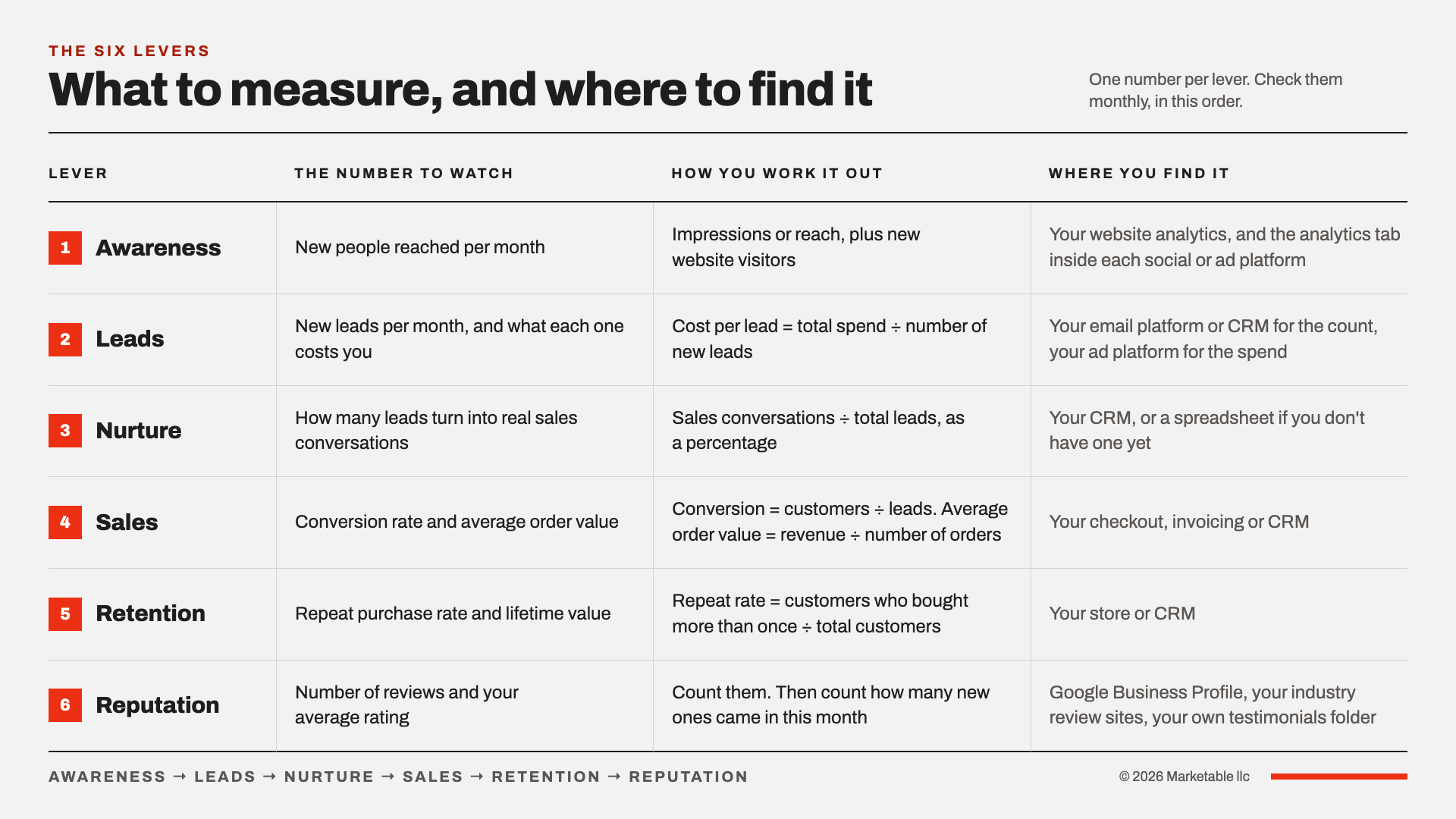
Lever
The number to watch
How you work it out
Where you find it
Awareness
New people reached per month
Impressions or reach, plus new website visitors
Your website analytics and the analytics tab inside each social or ad platform
Leads
New leads per month, and what each one costs you
Cost per lead = total spend ÷ number of new leads
Your email platform or CRM for the count, your ad platform for the spend
Nurture
How many leads turn into real sales conversations
Sales conversations ÷ total leads, as a percentage
Your CRM, or a spreadsheet if you don't have one yet
Sales
Conversion rate and average order value
Conversion = customers ÷ leads. Average order value = revenue ÷ number of orders
Your checkout, invoicing or CRM
Retention
Repeat purchase rate and lifetime value
Repeat rate = customers who bought more than once ÷ total customers
Your store or CRM
Reputation
Number of reviews and your average rating
Count them. Then count how many new ones came in this month
Google Business Profile, your industry review sites, your own testimonials folder
These 6 growth levers should be reviewed monthly and is a high level reporting system of where to focus your energy and resources.
So where do you start? The Growth Grader
This lets us shift the focus from chasing the next shiny marketing tactic to asking a better question: where are the gaps and opportunities in my business right now?
That's where the Growth Grader comes in. For each of the six growth levers, we score ourselves and our clients out of five. Just to remind you, this is where you are going to score yourself for each growth lever on a scale of 1-5. You will be using the scale below to give scores, Here's what each score actually means:
1 — Non-existent. Nothing in place. Nothing happening. If you went on holiday for a month, nothing would change, because nothing was running anyway.
2 — Ad hoc. It happens when you remember, or when things go quiet and you panic. No routine, no measurement, no consistency.
3 — Consistent but blind. There's a genuine routine and it happens whether you feel like it or not. But you can't tell me what it produces, because you're not measuring it.
4 — Measured and improving. It runs consistently, you track the number, you know what it costs you and what it returns, and the number is moving in the right direction.
5 — A proven system with proven ROI. It runs without you. It's predictable. You know that if you put more money or more people into it, you get more out — and you know roughly how much.
Be 100% honest with yourself here. Almost nobody is a 5 on anything, and the whole point of the exercise is to find the weak spot, not to feel good about the strong one.
Once we have the scores, we're looking for the two growth levers that need immediate attention. Generally, those are the two lowest-scoring levers.
There's one exception to that rule. If your awareness and leads are scoring below a three, you focus there first, no matter what the other scores look like.
Without a front end feeding the business, fixing anything downstream is pointless and you'd be polishing a nurture sequence that nobody's entering.
What this looks like with real numbers
Let me make this concrete for you and use an example. Let's say you're a business coach doing around $300,000 a year, mostly from referrals and repeat clients. You sit down and score yourself honestly:
Lever
Score
Why
Awareness
2
Posts on LinkedIn when he thinks of it. No ads. No consistent content.
Leads
1
No opt-in on the website at all. No list. Enquiries come by DM or referral.
Nurture
1
Nothing automated. No welcome sequence. No newsletter.
Sales
4
Excellent on a call. Closes roughly half the people he speaks to, and he tracks it.
Retention
2
Clients love him, but there's no second offer for them to move on to.
Reputation
3
A handful of good testimonials, no systematic way of collecting them.
Now look at what that tells you. His sales lever is a 4. That means he's brilliant when he gets in front of a prospect and needs to close.
You may think, that’s awesome, let me just focus on getting better at selling or run a promotion. That’s a great goal, but right now sales are not the weak link in your business. The problem is that hardly anyone ever reaches it (the sales pitch). There isn’t a proven system for raising awareness, getting leads and nurturing those leads.
His two lowest are leads (1) and nurture (1). But the exception rule kicks in: awareness is a 2 and leads is a 1, both below three. So awareness and leads are the focus. Nurture waits.
The next 90 days are only about moving those two from a 1 and a 2 to a 2 and a 3. Not to a 5. Just up one notch. It's all about awareness and leads. That's it.
That's the whole quarter. Nothing else gets touched. No new platform, no rebrand, no podcast, no new YouTube channel…unless it is all about building awareness and getting your scores up.
Turn it into a 90-day sprint
Once we've picked the two levers, that becomes our 90-day sprint. We don't focus on anything else other than improving the score of those two lowest-scoring levers.
That 90-day sprint gets broken into months, then into weeks, then into days. We share it with the team and that’s the focus area. There are action items, due dates and priorities against each one.
That way we have focus. Everybody is on the same page. We're not chasing shiny objects and we're not hunting for the next tactic. We're operating from a strategy to get where we want to be.
And then what happens after 90 days?
You re-score. Same six levers, same honesty, same one-to-five scale.
One of two things will be true.
The score moved, or it didn’t, and before you beat yourself up, just know that can happen. But now you have data, a system, and a way to measure the effectiveness of your marketing.
That way, you know you now have to improve the effectiveness of the actions you’re taking to ensure the growth of each lever. Part of this post-90-day sprint is scoring the growth levers again (otherwise you won't know your scores), and then you go again.
This is so powerful to get you and your team all knowing exactly what your focus is for the next 90 days, each month and each week. All of a sudden, 1 quarter turns to 2, which turns to 4, and eventually you’re 7 quarters deep…
And your business has grown, your resources are used more efficiently and effectively, and your team is happy. Not only because they have results with the company, but because they feel empowered and have clarity.
"But I'm a one-man band"
That’s even better, because the biggest roadblock to you growing is you. Without focus and systems, you’ll be stuck working 24/7, no holidays, no breaks, and not enjoying your work. Chances are you’ll become a stranger to your family too.
I'm not giving you extra work here; I'm giving you more focus on what you should be doing and better outcomes for your marketing and business growth.
Where to start
Score yourself now and don't put it off. Six levers, one to five, and be totally honest. Find your lowest two, and check the awareness and leads exception before you commit. Then give it 90 days of focus and energy and don't get distracted by anything else.
If you want to find out more about the six growth levers and score yourself properly, click below and take your own mini assessment.
Chat soon and here’s to your growth,
Kenneth